
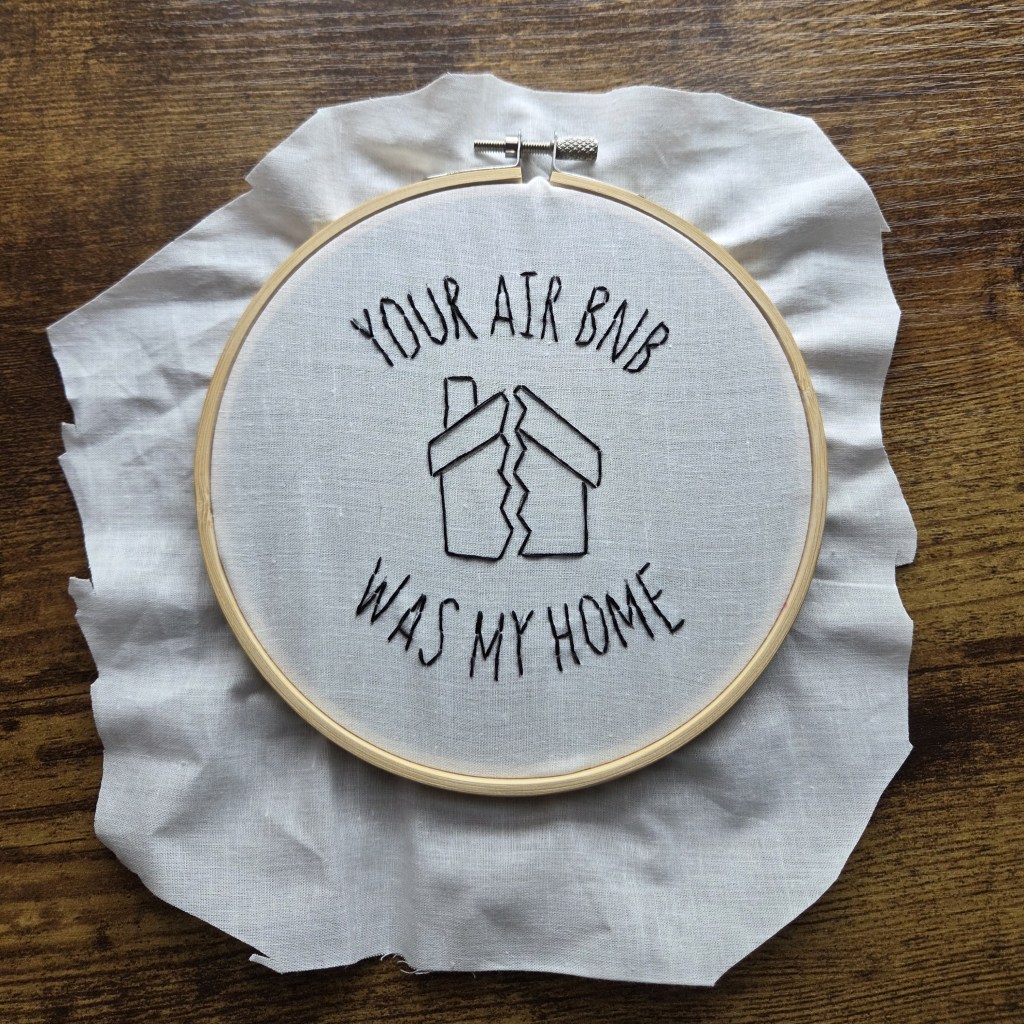
I recently completed an embroidery piece that reads “your Airbnb was my home”, beside an image of a house broken in two. It’s a quiet act of craft, but its message is urgent: in Ireland, homes are being taken away from people and converted into commodities. Children, families, and emigrants are living with the consequences.
The Crisis in Numbers
In August 2025, more than 5,000 children were living in emergency accommodation in Ireland, out of over 16,000 people in total (Irish Times). These numbers don’t include the “hidden homeless”: people sofa-surfing, staying with relatives, or crammed into overcrowded housing.
Every statistic is a story, a child trying to go to school without a permanent bed, a parent scrambling to keep a family together, a community fractured by loss. When families are placed in temporary housing it’s often miles away from their communities and support networks. Not only does this have a negative impact on child development and quality of life, it means that it is harder for communities to organise and fight back.
Short-Term Lets and Rising Rents
At the same time, tens of thousands of homes across Ireland are tied up in short-term lets. One estimate put the figure at 20,000 properties, compared with just 2,300 homes available for long-term rent on some days (Planning Permission Ireland).
This shortage directly drives up costs. In 2025, the average rent surpassed €2,000 per month nationally for the first time (Irish Times). The number of available rentals fell 14% in a single year, while cities like Limerick saw over 20% increases in rents year-on-year (Kildare Now).
The logic is simple: when homes are converted to tourist lets, fewer remain for people who actually live and work here. That scarcity makes the rest more expensive.
Questioning the “Airbnb Isn’t to Blame” Narrative
In April 2025, an ESRI report suggested Airbnb was not a significant factor in the housing crisis. But the study only looked at the years 2019–2023. By then, Airbnb was already well-established.
This is a flaw worth pointing out. By starting the clock after Airbnb had already expanded, the report misses the years when thousands of homes were first withdrawn from the long-term rental market. If you only examine the most recent period, when much of the damage has already been done, you risk concluding that Airbnb “isn’t to blame,” while ignoring its earlier role in worsening the shortage.
Short-term lets are not the sole cause of the crisis, but they poured fuel on the fire. They helped normalise housing as an investment, not a right.
Emigration and the Right to Return
Many people are leaving Ireland for better lives abroad. With rent and mortgages being so high, young people are faced with the prospect of staying in Ireland and likely never leaving their childhood bedroom or moving to Australia, Canada or UK. (IrishIndepentent)
Those who already left during the economic crisis of 2008, are now finding themselves in that middle generation, with young children to care for but also aging parents in Ireland. Many cannot afford to return home. High rents and stricter mortgage rules make resettling impossible for some (IrishCentral).
It echoes older patterns of emigration, even the Great Famine: people forced to leave not just temporarily, but indefinitely, cut off from the possibility of return.
Migrants and Misplaced Blame
It’s also vital to be clear about who is not responsible for this crisis. Migrants seeking safety and opportunity in Ireland are not the cause of housing shortages. The real roots lie in underinvestment in social housing, speculation, weak regulation of short-term lets, and decades of treating homes primarily as assets.
Pitting vulnerable groups against each other only obscures the real issues.
Stitched Protest and Shared Hope
When I stitched “your Airbnb was my home”, I was giving form to my own grief and anger; taking the powerlessness that I feel and making it tangible for others to see. Behind every Airbnb listing, there could have been a child’s bedroom, a family’s front door, a neighbour’s home.
But what has struck me most is the response. When I shared this piece online, it received hundreds of comments and thousands of likes. People from around the world wrote to say how it resonated with the housing struggles in their own cities. Others shared how their governments had restricted or banned short-term lets to protect housing, showing that change is possible.
This is the power of craftivism: a heartfelt message stitched with thread, in a non confrontational way was able to cross borders and spark conversations. It reminds us that housing struggles are global, but so too is solidarity. There is hope and your voice matters.

 Jack's Yarn Crochet Designs
One reply on ““Your Airbnb Was My Home” Craft, Protest, and the Irish Housing Crisis”
[…] my craftivism, I’ve already been trying to do that. Projects like Tax Wealth Not Work, Your Airbnb Was My Home, and Trans Rights Are Human Rights were all ways of stitching stories — using thread and fabric […]
LikeLike